
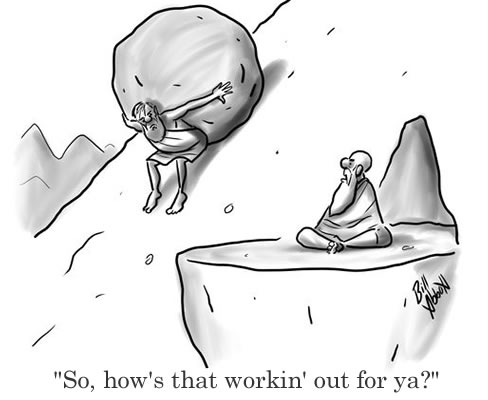
You are Sisyphus, condemned by the gods to push a boulder up a hill, only to watch it roll back down so you can push it up again in an endless cycle of pointless struggle. You are constantly oscillating between tension and release; tension the uphill side, release the downhill side. You might consider the highpoints rightness, but they’re really just a brief respite from not-rightness (as any housewife can tell you, a job well done need always be done again, usually tomorrow). This pulsing tide of tension and release provides the dramatic impetus that keeps you paddling in a random direction at an arbitrary speed on the shoreless sea of nothing forever. In other words, this pattern is the heartbeat of your life.
This pattern is the alternating current of expansion and contraction. Emotion powers the process and the mother of all emotions is fear; fear of what happens if you stop struggling, fear of what lies beyond your senses and reckoning. You can call it fear of the unknown or fear of no-self, but ultimately, it’s fear of truth. Being afraid of truth, can you imagine such a thing?
Blinking your eyes and wiggling your toes are expressions of this tension-release wave pattern no less than leaping from a burning building or waking from delusion. Right now, for instance, I am developing a hunger that will soon peak, at which time I’ll go eat something. Satiety isn’t the promised land, it’s just a period of not-hungry. At the same time, I am experiencing a mounting sense of wrongness over some undone chores, so I’ll get around to those and that pattern will enter a release phase until the next wave builds. At the same time, I’m working on a two-year writing project that’s in the productive rising-tension phase, I have an itch on my left ankle that needs scratching, my coffee needs a warm-up, a nearby mosquito needs swatting, my gutters are crying out for attention and my cuticles are in complete disarray. That’s just in my super-streamlined life; factor in family, career, community and a whole host of various whatnots and the list expands exponentially, not one big boulder but many little ones, a million plates that must be kept spinning lest chaos ensue and anarchy reign.
How many little boulders are you pushing up the hill every day? How many plates do you keep balanced and spinning? What if you just stopped and let gravity win the day? What if you quit your fevered paddling and just slipped over the rail into the inky blackness? Maybe you’d die, or maybe something else; maybe something wonderful or maybe something sucky. Or, you can just keep doing what you’re doing, stay in the boat and keep paddling for all you’re worth for as long as you’re able, as most most certainly do. Another solution – the happy medium – is to eliminate non-essentials and strive to minimize struggle and achieve simplicity. “A man is rich,” Thoreau teaches us, “in proportion to the number of things which he can afford to let alone.”
Equilibrium is always sought but never found. The pendulum swings too far one way, then too far the other. Steering is binary, not analog. Correct one way and the opposite correction will soon be required. That’s how we maintain our relatively friction-free place in the herd. Adults are in their own private pattern but the same rules apply, just with fewer external influences to be compensated for; the difference between a rush-hour freeway and a quiet country lane.
A pencil sits on my desk in a state of repose; at peace, neutral, unconflicted. This offends me. I pick up the pencil, hold it in both hands and press my thumbs against it to bend it toward breaking. The pencil was at peace but is now in a state of dynamic tension with two internal but opposing forces seeking expression; the compression side pushing together, the tension side pulling apart. The whole pencil is bending in the same direction, but internally there is profound conflict. Thus, dynamic tension becomes dramatic tension, thanks to which actors and audience remain engaged and the show that must go on does go on. (No pencils were harmed in the writing of this article.)
We, as humans in general and perennial juveniles in particular, tend to ascribe rightness and wrongness to these cycles – hunger/bad food/good, tired/bad sleep/good, pain/bad no-pain/good – but as Prince Hamlet reminds us, there is nothing either good or bad but thinking makes it so. Pain isn’t bad per se, we (most of us) just don’t like it. Maybe, in some cases, pain is the lesser evil, so you let a few plates crash and smash, and maybe a few more. Not only did you survive the noisiness and messiness, but life, you notice, just got better. Maybe you could smash a few more, maybe a lot more.
Regardless of source or cause, we all live in this constant state of dynamic tension. We try to maintain an orderly wave pattern but occasionally there are upward and downward spikes – euphoria, dysphoria, existential meltdown, love, bliss, zombie apocalypse – that demand our full attention (and the occasional crossbow). When sages promote simplicity, it’s the elimination of unnecessary struggle they’re talking about, i.e., you don’t have to kill all the zombies, just the ones that are getting in your face. Spin fewer plates. Push fewer rocks. Instead of paddling like you’re in a race or a storm, paddle like it’s a sunny Sunday in the park. There’s a big difference between paddling away from fear and paddling toward function.
If your spiritual search is motivated by desire, the good news is that you’re probably already where you’re meant to be; seeker, search and sought are one. If you are driven by an insatiable need to escape your present circumstances, regardless of cost, then the news is not so good but your prospects are much brighter – maybe. In order to wake up from the dreamstate (not recommended) you must give up the Sisyphean struggle, slip quietly overboard and let yourself sink. In order to wake up in the dreamstate (highly recommended), then when it comes to those spinning plates, less is definitely more. We’re not condemned by gods to push that boulder, we’re just afraid of what will happen if we don’t. The way to overcome fear is always to open your eyes and look, in other words, think.